

Written by
Matrishvan RavalReading time: 4 minutes
May 1, 2026
Design & Optimization of Axial Flux Motors
Electromagnetic, thermal, and manufacturing unlock the full potential of this technology.
Designing traction motors requires balancing torque density, efficiency, thermal limits, and manufacturability within increasingly constrained packaging envelopes. These factors are tightly coupled, and improvements in one area often introduce tradeoffs in another.
Axial flux motor architectures approach these constraints differently than conventional radial flux machines, offering an alternative set of design tradeoffs that can be leveraged to optimize performance at the motor level.
While many factors affect their operation, axial flux motors have high performance because the magnetic flux is parallel to the axis of rotation unlike traditional motors. where the flux is radial. This geometric difference alters torque generation, efficiency scaling, and packaging characteristics. Because of this, axial flux motors provide more torque and power in a smaller footprint.
In axial flux motors, torque scales approximately with the cube of the rotor’s diameter rather than the square in radial machines, making them attractive for high-torque, space- and weight-constrained applications. Simulation-driven optimization, design for manufacture, and design for reliability, enable high performance and manufacturing at economies of scale at competitive cost.
Electromagnetic Architecture & Magnet Optimization
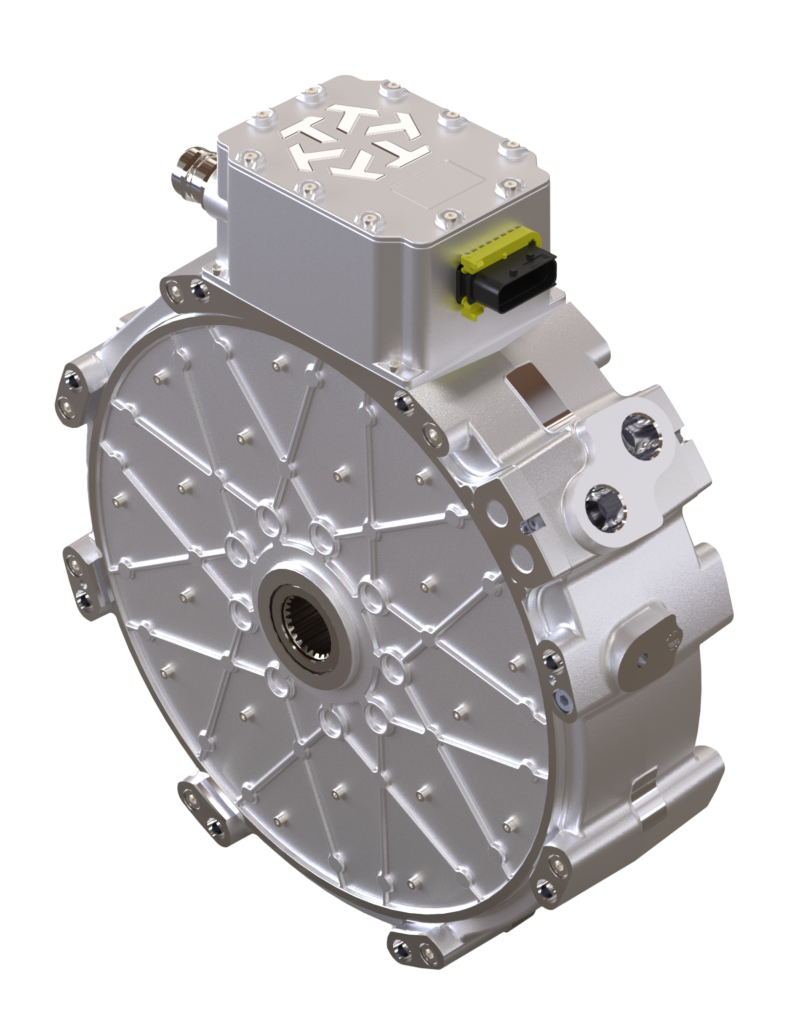
Single-rotor axial flux topology with rare-earth permanent magnets, in contrast to many other designs with dual rotors has several engineering advantages:
- Reduced rare-earth magnet use, lowering material costs and supply chain issues
- Lower rotor inertia, improving transient response
- Improved mechanical robustness because the rotor is enclosed within the motor housing
From an electromagnetic standpoint, magnet optimization focuses on balancing the airgap flux density; torque ripple; and noise, vibration, and harshness (NVH) performance. Multidimensional design of experiments and electromagnetic simulations are used to optimize:
- Magnet material grade selection
- Rotor pole and stator slot combinations
- Active material used for maximum torque and power density
These optimizations enable up to four times the torque and power density of equivalent radial flux motors, while achieving IE4-class efficiency.
Stator Design & Winding Configurability
Distributed windings are often preferred over concentrated windings when torque smoothness, reduced harmonics, and improved NVH performance are priorities.
From an electrical engineering perspective, distributed windings affect:
- Torque smoothness: Distributed windings reduce spatial harmonics in the airgap flux
- Loss distribution: Lower rotor losses occur because of improved flux waveform quality
- NVH performance: Reduced cogging torque and electromagnetic noise
Configuring stator turns allows designers to adapt the motor to different voltage classes [400-volt (V) and 800-V architectures] and for different application requirements.
From a design standpoint:
- A higher number of turns increases the back-electromotive force (EMF) constant (Ke) and reduces phase current for a given torque. This turn count is typically suited for higher-voltage systems and efficiency-focused duty cycles
- A lower number of turns lowers back-EMF and allows for higher current operation. This turn count level is suitable for high peak torque or lower voltage applications
This flexibility allows the same mechanical platform to support traction, electric power take off, and auxiliary applications without fundamental redesign.
Torque Density, Power Density, & System-Level Impact
The defining advantage of the axial flux form factor is its high diameter-to-length (D/L) ratio, which shortens the magnetic flux path and increases field strength. The physics deliver:
- Class-leading torque and power density
- Compact axial length, ideal for space-constrained systems
- Up to a 50% reduction in motor weight, compared to radial flux motors
At the system level, this translates into:
- Reduced powertrain mass
- Lower gearing requirements because of the high torque at low speed
- A virtuous cycle of vehicle weight reduction and increased range
- Lower total cost of ownership
Cogging Torque & NVH Optimization
Cogging torque is a critical concern in permanent magnet machines, particularly in traction and precision-motion applications. Low cogging torque is achieved through:
- Optimized stator tooth and rotor pole geometry
- Distributed winding architecture
- Balanced magnetic forces in the single-rotor design
This also results in superior NVH performance compared to other axial flux motors that use segmented stator teeth or dual-rotor configurations.
Thermal & Thermofluidic Optimization
Indirect water cooling using standard water and ethylene glycol simplifies vehicle integration by using standard thermal management systems and avoids the complexity associated with oil-cooled designs.
Key thermal innovations include:
- Detailed conjugate heat transfer analysis
- Optimized cooling channel and port geometry suitable for die casting
- Thinner, lighter cooling plates that improve heat extraction and enhance torque density
For higher power applications, thermofluidic optimization extends to multi-stack motor designs, with pressure-drop analysis and channel optimization. This ensures uniform cooling and consistent performance across stacks.
Design for Manufacture & Reliability
To increase availability and make the motors cost-effective, they must be designed for high-volume manufacturing, using:
- Die-cast structural components
- Stamped stator cores based on proven industrial processes
- Reduced part count through extensive DFM on subassemblies 20
Reliability engineering includes:
- Detailed shaft stress analysis assuming an infinite lifetime
- Mechanical finite element analysis to ensure rotor stiffness
- Validation via durability rigs, spin testing, and insulation life models
These measures support a validated product lifetime of up to 50,000 hours for the reference duty cycle.
Benchmarking & Competitive Position
Benchmarking indicates that optimized axial flux motor designs can achieve higher continuous volumetric power density than comparable radial flux machines, as well as improvements over less optimized axial flux configurations. These results reflect the impact of electromagnetic and thermal design choices on sustained motor performance.
Subscribe to our newsletter
Power your decisions with expert electrification and hybrid system insights. Subscribe today.
By subscribing you agree with our privacy policy
Featured
Market Update: Flexible Powertrains & Onboard Energy Move Toward Deployment
Manufacturers keep several powertrain and battery options open, while commercial fleets and railways shift from
Read More
Blog Posts
Market Update: Flexible Powertrains & Onboard Energy Move Toward Deployment
Market Update: Infrastructure, Financing, & Scale Set the Pace for Electrification
Market Update: Truck Manufacturers Seek Complete Transport & Energy Systems
Market Update: Shifts from Components to Complete Systems