

Written by
Jason GlassReading time: 6 minutes
April 6, 2026
Hybrid Systems & the Electrified Future of Heavy-Duty Mobility
Technology offers a flexible, application-specific route to lower emissions and an improved bottom line.
Hybrid systems and the electrified future of heavy-duty mobility rely on the adoption of axial flux motor techology. Across on-highway, off-highway, marine, and industrial equipment sectors, the path to decarbonization is rarely linear. Real-world duty cycles, infrastructure limitations, cost pressures, and regulatory diversity mean that a single powertrain solution cannot meet every operational need. Hybrid systems have emerged not as an interim compromise but as a durable and scalable architecture for the future of mobility and work machines.
Rather than framing electrification as an all-or-nothing transition, hybridization allows manufacturers and operators to tailor power systems to specific applications. In some cases, internal combustion engines remain essential for sustained power delivery, extreme environments, or long-range operation requirements. In others, full-electric systems are well-suited for urban, low-noise, or emission-restricted use. Hybrid platforms fill the wide middle ground, balancing energy density, flexibility, and operational resilience.
The hybrid systems focused on gasoline- or diesel-powered engines combined with a battery, and electric motor. This approach allows vehicles and equipment to dynamically select the most appropriate operating mode based on location, load, or task. In practice, hybridization provides several advantages.
First, hybrid systems provide range confidence without sacrificing efficiency, especially with high-efficiency axial flux motors. Hybrid systems experience some of the same benefits as a fully electric system, such as regenerative energy recovery. Second, hybrids enable compliance with increasingly complex emissions and noise regulations, particularly in urban environments or ports where electric-only operation may be required.
Hybrid platforms also offer manufacturers a way to electrify existing vehicle and equipment classes without requiring full redesigns or reliance on charging infrastructure that may not yet exist at scale. This makes hybridization especially compelling for commercial fleets, construction equipment, marine vessels, and industrial machinery where uptime and predictability are critical.
Hybridization Beyond Traction
While hybridization is often discussed in the context of vehicle propulsion, its value extends well beyond traction. Modern work machines rely on multiple energy-intensive subsystems, including hydraulics, power takeoff units, auxiliary drives, and onboard power generation. Electrifying these systems within a hybrid architecture unlocks additional efficiency and control benefits.
Electrified hydraulic pumps, for example, can operate independently of engine speed, improving responsiveness, and reducing parasitic losses. Electrically driven auxiliary systems allow power to be allocated precisely where and when it is needed, rather than continuously drawing mechanical energy. In stationary or low-speed operation, hybrid systems can function as onboard generators, supplying powertools, refrigeration, or grid interaction without engine operation or idling.
This multirole capability is particularly valuable in off-highway, marine, and specialty vehicle applications, where equipment may alternate between propulsion, work functions, and stationary power production within a single duty cycle.
The Role of Advanced Electric Motor Technologies
At the center of any hybrid system is the electric motor, and motor selection has a significant impact on packaging, efficiency, and system performance. Among available motor topologies, axial flux designs have gained increasing attention for hybrid and electrified applications because of their unique structural advantages.
Axial flux motors differ from traditional radial designs by arranging magnetic flux parallel to the axis of rotation. This configuration enables a compact, disclike form factor with high torque relative to its size and mass. For space-constrained hybrid systems, this architecture offers clear benefits.
Why Axial Flux Motors Are Well Suited to Hybrid Systems
One of the primary advantages of axial flux motors is their compact geometry. With a flat, short axial length, they can be integrated in-line with existing drivetrains or mounted in locations that would be impractical for longer, radial motor designs. This makes them especially attractive for retrofitting hybrid functionality into established vehicle and equipment platforms.
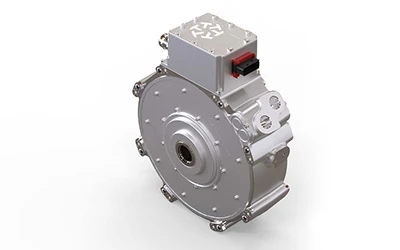
Axial flux motors also deliver high torque, which can reduce or simplify mechanical gearing. In hybrid systems, this translates to smoother power blending between the engine and electric drive, improved low-speed control, and greater flexibility in system layout. Lower rotational inertia further enhances responsiveness, benefiting applications that require frequent starts, stops, or load changes.
From a system-level perspective, these motors support a wide range of operating modes. They can assist engines during high-load events, recover energy during deceleration, drive equipment electrically at low speeds, or operate as generators when mechanical power is available. This versatility aligns closely with the multi-flow nature of modern hybrid architectures.
Parallel Systems
Most current hybrid vehicles include parallel hybrid systems using either gasoline, biofuel, or diesel. In a parallel hybrid architecture, the internal combustion engine (ICE) and electric machine are mechanically coupled to the driveline through a clutch, coupling, or transmission. Either source can deliver torque to the wheels (or to a PTO/work function) independently or in combination. A battery and inverter supply the electric machine, and a supervisory controller blends torque based on driver demand, state of charge, and operating constraints.
During launch and low-speed operation, the motor can provide traction assist and enable engine-off creeping. At higher, steady loads the ICE supplies the bulk power near its efficient operating range. Regenerative braking routes driveline energy back through the motor, now acting as a power generator, to recharge the battery, reducing fuel use and brake wear. Compared with series hybrids, the parallel layout can achieve high efficiency at highway speeds because engine power does not need to be fully converted to electrical power before reaching the wheels.
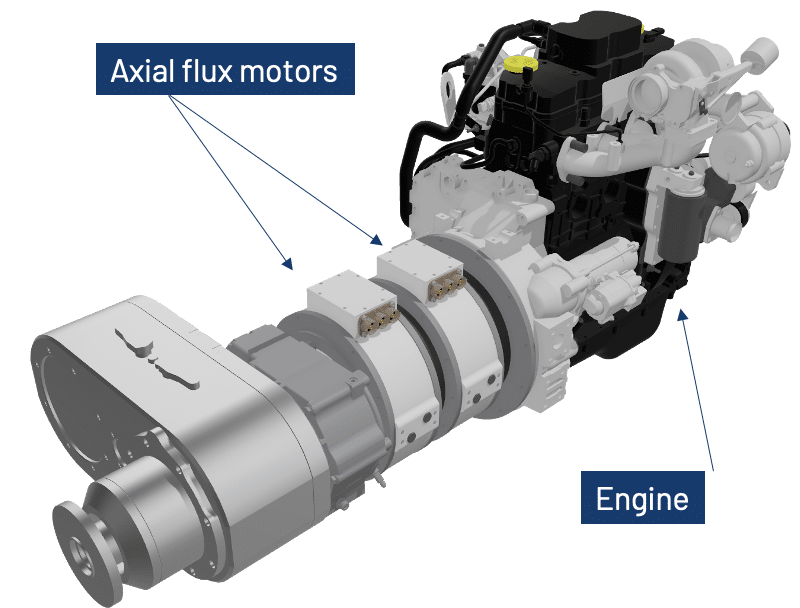
Using an axial flux motor in this system improves packaging and performance. Its disc-like geometry supports in-line integration in limited axial space, often with minimal drivetrain rework. High torque density and low rotor inertia improve transient response and torque smoothing during engine start/stop and gear shifts, while the motor’s strong, low-speed torque can reduce required gear ratio spread and enhance gradeability and work-cycle control.
Series Systems
In a series hybrid system, the ICE is not mechanically connected to the drive axle. Instead, the engine drives a generator, producing electric power that is conditioned by a power electronics stage and delivered to an electric traction motor and/or stored in the battery. Vehicle propulsion is therefore fully electric, with torque to the wheels provided by the motor through a reduction gear, while the engine is managed primarily as an energy source.
A controller schedules engine operation to maintain battery charge and meet sustained power demand, allowing the engine to operate at its best efficient point and shut off when not needed. This architecture simplifies the mechanical driveline and can improve packaging, enable electric-only operation, and support precise low-speed control for stop-and-go, urban, marine, or work-cycle applications.
However, because propulsion power passes through multiple energy conversions (mechanical to electrical and back to mechanical), series systems can incur higher conversion losses at continuous highway-speed operation compared with parallel hybrids. The separation of engine speed from wheel speed also makes series hybrids well-suited to range-extended electric platforms, where the generator is sized for average demand, and the battery supplies peak power and absorbs regenerative braking energy.
Axial flux motors can strengthen a series hybrid system by improving the efficiency and packaging of the all-electric traction path. Their high torque density supports a smaller, lighter traction motor for a given wheel-torque requirement, which can reduce axle mass or free volume for the battery and cooling hardware. Low rotor inertia and strong torque response improve drivability in engine-decoupled operation, helping the controller smooth generator start/stop events and track torque commands precisely during frequent load changes.
Because a series system relies on electric conversion for propulsion and regenerative braking, high motor efficiency across a broad speed range directly increases recovered energy and reduces waste heat, easing thermal management demands. The flat, disc-like form factor also allows for flexible mounting locations (e-axle, near the reduction gear, or integrated with accessory drives), supporting modular range-extended platforms and simplifying integration into space-constrained equipment.
Supporting Smarter, More Adaptive Powertrains
As hybrid systems evolve, software and control strategies are becoming as important as hardware. Advanced hybrid platforms can automatically transition between power sources based on geolocation, operating conditions, or regulatory requirements without driver or operator intervention. Electric machines that respond quickly and integrate cleanly with mechanical and electric systems are essential to enabling this level of automation.
Axial flux motors, with their high torque density and flexible integration options, support these adaptive strategies by enabling multiple power paths within a single architecture. Whether operating in electric-only, engine-only, or blended modes, the motor serves as a central enabler of efficiency, compliance, and performance across diverse use cases.
A Practical Path to Sustainable Mobility
As stated, the future of hybrid systems and electrified mobility relies on axial flux motor technology. The transition to lower-emissions mobility will not be defined by a single solution (electric or hybrid), but by systems that reflect how vehicles and equipment are used. Hybrid architectures acknowledge this reality, offering a pragmatic balance between electrification, performance, and operational reliability. By extending electrification beyond traction and pairing hybrid systems with axial flux motors, manufacturers can deliver meaningful efficiency gains while building a foundation for the future.
In this context, hybrid systems are not a temporary solution. They are a strategic platform that enables cleaner, quieter, and more adaptable machines across on-highway, off-highway, marine, commercial, and industrial sectors while supporting the long-term evolution of electrified powertrains.
Subscribe to our newsletter
Power your decisions with expert electrification and hybrid system insights. Subscribe today.
By subscribing you agree with our privacy policy
Featured
Hybrid Systems & the Electrified Future of Heavy-Duty Mobility
Technology offers a flexible, application-specific route to lower emissions and an improved bottom line.
Read More
Blog Posts
CONEXPO 2026 Trends: Hybrid Systems Are the Future in the Construction Industry
Powering India: Minda Corporation & Turntide to Form a Joint Venture
Turntide to Unveil Proven, Scalable Axial Flux EDU During CONEXPO
Turntide Axial Flux EDU Validated Under Extremes at King of the Hammers