

Written by
Jason GlassReading time: 3 minutes
June 17, 2026
The Axial Flux EDU That Fits Every Restomod Vehicle
This technology simplifies retrofitting classic cars with electric systems.
The restoration-modification (restomod) market for electric classic vehicles is forecast to reach $12.4 billion by 2033 at 20.3% CAGR. The commercial EV retrofit market is $68 billion and growing at 17%. An axial flux electric drive unit (EDU) is filling a need in the restomod market. This is an engineering observation, and it took months of STEP file analysis, space claim work, and competitive research to fully understand the gap in the market. What is it, and why is it important?
The Challenge
Electric drivetrain conversion has fragmentation issues. To electrify a Land Rover Defender, an end user would need to look outside the U.S. for a restoration-modification (restomod) provider. If you want to convert a Porsche 911, an end user would need to go to California or pay more than $310,000 for a build. For a Jeep Wrangler, the cost would be $150,000 to $225,000 for a finished vehicle. If you want a classic truck (C10, F-100, or Scout), an end user is largely on their own.
Every platform has its own specialist. Every specialist has a proprietary powertrain. They don’t talk to each other. And none of them can give you the same motor and gear set in a Porsche and a Jeep and a Ford Bronco from the same parts catalog. That’s the gap that the axial flux EDU fills.
The Solution: One Motor | A Gear Set | Three Housings | Every Classic Vehicle
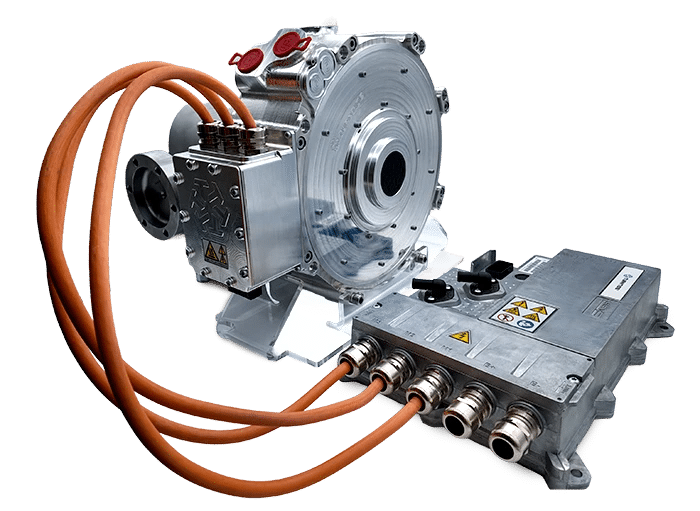
The axial flux EDU is built around a single core: An axial flux motor, 73 kilowatts (kW) to 213 kW of continuous, depending on configuration, driving through a gear set at 4.56:1, with live or constant-velocity (CV) axle outputs. That core assembly—motor, gear set, carrier, bearings, CV axles—is identical across every application. What changes is the housing.
Solid axle is the traditional high-pinion, beam axle configuration. The motor mounts where the driveshaft yoke sits on the gear set. It slides it onto the custom pinion shaft, simplifying installation. This covers many vehicles including:
- Jeeps from the CJ-5 through the JL Wrangler
- Land Rover Defender and series axle
- Ford Bronco first generation
- Scout 800
- Classic trucks
Independent front suspension (IFS) and independent rear suspension (IRS) are the same core assembly in a housing with CV axle outputs. This opens front-wheel drive platforms like Peugeot Vans, Ford Escort RS, and rear IRS fitment on platforms like the Porsche 924, 944, and 928. A housing swap (same center section) is that is needed to convert between IFS and solid axle modes because the motor doesn’t move.
Mid-engine transaxle housings can be more complicated to work on than other layouts. In a rear-engine, rear-wheel-drive vehicle, such as a Porsche 911, Volkswagen (VW) Beetle, VW bus, or Ferrari 308, the motor and differential sit together at the rear axle, outputting through 930-style CV flanges. The 930 CV joint is the universal output standard across the entire VW and Porsche drivetrain family from 1965 to 1998. Some manufacturers already make Tesla-to-Porsche-930 stub axle adapters. This confirms that this is an accepted interface for VW-Porsche electric-vehicle (EV) conversions. The axial flux EDU simply does it in a production-backed, purpose-built package.
The VW Beetle is the most-produced single car model in history, with 21.5 million units manufactured. The air-cooled Porsche 911 was built for 35 years and with more than 400,000 examples. The combined VW-Porsche transaxle family represents tens of millions of potential donor vehicles globally. The axial flux EDU is built for these models and more.
Differential Flexibility | One Carrier Bore
The other important design decision is the differential architecture. The axial EDU accepts all many differential options in the same carrier bore:
- Open differential is standard and clean with no additional cost. Right for transaxle builds, street European classics, and any application where traction management is managed by the motor controller.
- A helical gear with limited-slip is fully automatic with no electronics, no friction plates, and zero maintenance. This system is said to transfer up to 3.5 times more torque to the high-traction wheel. And it is recommended for EV applications because it requires no electronic integration. For a restomod build where you want to keep the wiring clean and the installation simple, the TruTrac is the answer.
- An electromagnetic push-button full locker is open until you need it. Then 100% torque travels equally to both wheels. It can be integrated into the electronic control unit for automatic engagement logic. This is similar to a factory traction package now available as a fully electric EDU for the first time.
The Solution for Restomod Shops
Other EV conversion technology provides an open differential, which is fine for street travel but useless on a trail when one wheel is in the air. The axial flux EDU includes the same open differential in a fully electric package. It provides manufacturer-level traction technology with EV torque, an ideal combination. There was no production-backed universal EDU addressing both. There is now.
Subscribe to our newsletter
Power your decisions with expert electrification and hybrid system insights. Subscribe today.
By subscribing you agree with our privacy policy
Featured
Market Update: Flexible Powertrains & Onboard Energy Move Toward Deployment
Manufacturers keep several powertrain and battery options open, while commercial fleets and railways shift from
Read More
Blog Posts
Market Update: Flexible Powertrains & Onboard Energy Move Toward Deployment
Market Update: Infrastructure, Financing, & Scale Set the Pace for Electrification
Market Update: Truck Manufacturers Seek Complete Transport & Energy Systems
Market Update: Shifts from Components to Complete Systems